How to Identify Fake Reviews, AI UGC Videos & Misleading Marketing Before You Buy (2026 Consumer Guide)
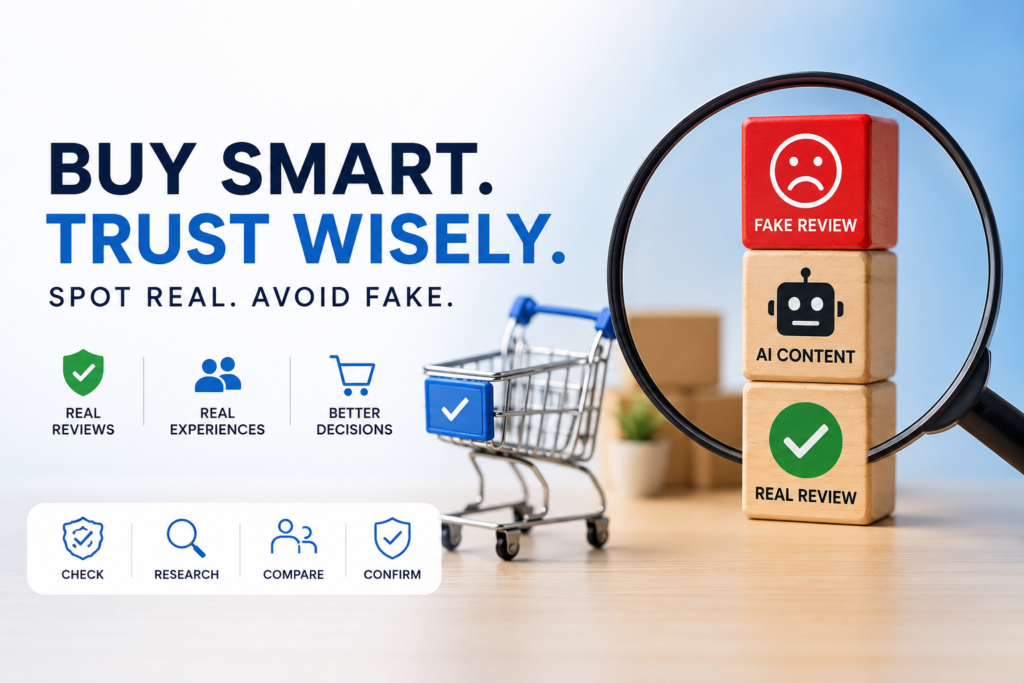
Have you ever bought a product after watching an impressive Instagram Reel, YouTube Short, or Facebook video, only to discover that it didn’t live up to the hype?
You’re not alone.
Today, artificial intelligence (AI) has transformed digital marketing. Brands can create realistic User-Generated Content (UGC) videos without hiring real customers. AI avatars can speak naturally, showcase products, and even appear to share personal experiences. At the same time, influencer marketing has grown rapidly, with many creators promoting products through paid partnerships or affiliate programs.
While these marketing techniques are not inherently wrong, they can make it difficult for consumers to distinguish between authentic recommendations and promotional content. Combined with fake online reviews and misleading testimonials, making an informed purchase has become more challenging than ever.
This guide will help you identify trustworthy products and services while avoiding common marketing traps.
Why It’s Becoming Harder to Trust Online Reviews
Modern consumers rely on online information before making purchasing decisions.
Most people check:
- Google Reviews
- Amazon Reviews
- YouTube Reviews
- Instagram Reels
- Facebook Recommendations
- Influencer Videos
- Short-form videos on various platforms
The problem is that not every review or recommendation reflects a genuine customer experience.
Some content is:
- Sponsored by brands
- Generated using AI
- Created solely for marketing campaigns
- Based on limited or no real product usage
This doesn’t automatically make the product poor—but it does mean consumers should evaluate claims more carefully.
What Are AI UGC Videos?
User-Generated Content (UGC) traditionally refers to content created by real customers sharing their experiences.
Today, AI can generate highly realistic videos featuring virtual presenters, synthetic voices, and scripted testimonials that appear authentic.
These videos are increasingly used because they are:
- Cost-effective
- Fast to produce
- Easy to localize into multiple languages
- Highly scalable for advertising campaigns
AI-generated UGC can be a legitimate marketing tool when used transparently. Problems arise when viewers are led to believe that AI-generated experiences represent real customer opinions.
Paid Promotions Are Not Always Bad
Many consumers assume that sponsored content is dishonest.
That’s not necessarily true.
Many influencers genuinely test products and provide balanced opinions. Ethical creators disclose paid partnerships and clearly separate facts from personal opinions.
The concern arises when:
- Sponsorships are hidden.
- Products are promoted without meaningful testing.
- Only positive aspects are highlighted.
- Important limitations are omitted.
Transparency is what matters.
How to Identify Fake or Misleading Reviews
Before trusting a review, look for these warning signs.
1. Reviews That Sound Too Generic
Be cautious if reviews repeatedly say:
- “Amazing product!”
- “Best purchase ever!”
- “Highly recommended!”
without explaining why.
Authentic customers usually describe specific experiences.
2. Hundreds of Reviews in a Short Time
A sudden spike in positive reviews over a few days may indicate an organized review campaign rather than organic customer feedback.
3. No Real Photos or Videos
Reliable reviews often include:
- Personal photos
- Videos of the product in use
- Details about long-term usage
4. Every Review Gives Five Stars
No product is perfect.
A healthy review profile usually contains a mix of positive, average, and negative feedback.
5. Repeated Writing Style
If multiple reviews use nearly identical wording or sentence structures, they may have been generated from the same template—or by AI.
6. Influencers Using Identical Scripts
If several creators repeat the same phrases, benefits, and examples, it’s likely they’re following a shared campaign brief rather than providing independent opinions.
Don’t Rely on One Platform
Always compare information from multiple sources.
Consider checking:
- Official company websites
- Independent review websites
- Consumer discussion forums
- Social media comments
- YouTube review channels
- Community discussions
When different independent sources consistently report similar experiences, your confidence in the information increases.
Read Negative Reviews Carefully
Many buyers only read five-star reviews.
Instead, examine one- and two-star reviews to identify recurring issues.
Ask yourself:
- Is the same complaint repeated?
- Does the company respond professionally?
- Has the issue been resolved?
- Are complaints recent or outdated?
Constructive criticism often reveals more than glowing praise.
Questions Every Smart Consumer Should Ask
Before making a purchase, ask:
- Does this company provide clear customer support?
- Is there a return or refund policy?
- Is the warranty explained?
- Are product claims supported by evidence?
- Are reviews spread naturally over time?
- Does the company respond to customer complaints?
- Are there independent comparisons available?
If several answers are “No,” proceed with caution.
How Ethical Brands Build Trust
Consumers increasingly reward brands that prioritize honesty over hype.
Trustworthy businesses typically:
- Encourage genuine customer reviews.
- Clearly disclose sponsored partnerships.
- Use AI responsibly and transparently.
- Respond to both positive and negative feedback.
- Share authentic customer experiences.
- Provide accurate product information.
- Offer realistic promises instead of exaggerated claims.
Long-term trust creates stronger customer relationships than short-term marketing tactics.
A Simple Consumer Trust Checklist
Before buying any product or service, score it using this checklist.
| Criteria | Yes | No |
|---|---|---|
| Verified customer reviews | ☐ | ☐ |
| Reviews available across multiple platforms | ☐ | ☐ |
| Independent product comparisons | ☐ | ☐ |
| Transparent pricing | ☐ | ☐ |
| Clear warranty | ☐ | ☐ |
| Return policy available | ☐ | ☐ |
| Responsive customer support | ☐ | ☐ |
| Balanced reviews (not only 5-star ratings) | ☐ | ☐ |
| Honest influencer disclosures | ☐ | ☐ |
| No obvious signs of fake review campaigns | ☐ | ☐ |
The more boxes you can confidently check, the more informed your purchasing decision is likely to be.
Final Thoughts
Artificial intelligence, influencer marketing, and digital advertising have made it easier than ever for brands to reach consumers. These technologies offer many benefits when used responsibly, but they also require consumers to think more critically before making purchasing decisions.
Rather than relying on a single video, review, or recommendation, compare multiple sources, look for transparency, and evaluate evidence instead of marketing alone.
An informed consumer isn’t someone who avoids advertising—it’s someone who understands how to separate promotion from proof.
1. How can I identify fake online reviews?
Fake reviews often use generic language, lack specific details, appear in large numbers over a short period, or come from accounts with little review history. Always compare reviews across multiple platforms and look for genuine customer photos and balanced feedback.
2. Are AI-generated UGC videos legal?
Yes. AI-generated UGC (User-Generated Content) videos are legal in many cases when used responsibly. However, brands should clearly disclose if content is AI-generated or sponsored, especially if it could influence consumer purchasing decisions.
3. Are all influencer promotions misleading?
No. Many influencers provide honest opinions and disclose paid partnerships. The key is transparency. Consumers should check whether the creator has actually used the product and whether the content is marked as sponsored.
4. Can Google detect fake reviews?
Google actively removes reviews that violate its policies, including spam, fake reviews, and manipulated ratings. However, not every fake review is detected immediately, so consumers should still evaluate reviews carefully instead of relying solely on star ratings.
5. What is AI UGC?
AI UGC (Artificial Intelligence User-Generated Content) refers to videos, images, or testimonials created using AI tools that simulate real customer experiences. These are increasingly used in digital marketing to create scalable promotional content.
6. How do I know if a product review is genuine?
Look for reviews that include:
Real product photos
Long-term usage experiences
Balanced opinions with both pros and cons
Verified purchases
Consistent feedback across multiple platforms
7. Should I trust products with only five-star ratings?
Not necessarily. A healthy review profile usually contains a mix of positive, average, and negative feedback. Products with only perfect ratings may deserve additional scrutiny, especially if the reviews are recent or repetitive.
8. How can businesses build customer trust?
Businesses can build trust by:
Encouraging genuine customer reviews
Being transparent about sponsored content
Providing accurate product information
Responding professionally to customer feedback
Using AI responsibly without creating misleading testimonials
9. Why is transparency important in digital marketing?
Transparency helps consumers make informed decisions, strengthens brand credibility, and builds long-term customer relationships. Honest marketing also reduces the risk of reputational damage and increases customer loyalty.
10. What is the best way to verify a product before buying?
Compare information from multiple trusted sources, read both positive and negative reviews, watch independent product demonstrations, evaluate warranty and return policies, and avoid making decisions based solely on short promotional videos.
Leave a Reply