Performance Marketing Strategy: How to Grow Your Business with Digital Marketing
By Aniruddha Ghosh | Performance & Growth Marketing Consultant
Every business wants more customers, better sales and higher revenue. However, achieving consistent business growth through digital marketing is not always easy.
Many businesses invest money in Google Ads, Facebook Ads, Instagram promotions and other digital channels but struggle to understand whether their marketing investment is generating real business results.
They may receive website traffic but very few enquiries. They may generate hundreds of leads but struggle to convert them into customers. In some cases, advertising costs increase while sales remain the same.
This is where a well-planned performance marketing strategy makes a difference.
Performance marketing is not just about running advertisements. It is about understanding customer behaviour, reaching the right audience, generating quality leads, improving conversion rates and measuring business results.
In this article, we will explore how businesses can use performance marketing to improve customer acquisition, increase sales and achieve sustainable business growth.
1. What Is Performance Marketing?
Performance marketing is a digital marketing approach where campaigns are planned, managed and measured based on specific business objectives.
These objectives may include:
- Generating qualified business enquiries.
- Increasing online product sales.
- Getting more website visitors.
- Generating property site-visit bookings.
- Increasing insurance policy enquiries.
- Improving customer acquisition.
- Increasing return on advertising spend (ROAS).
Unlike traditional advertising, performance marketing focuses on measurable actions and results.
For example, a real estate company may invest in digital advertising to generate enquiries from people interested in purchasing apartments. An educational institution may run campaigns to receive admission enquiries, while an e-commerce company may focus on generating online purchases.
Each campaign has a defined objective, target audience, budget and performance measurement system.
The main goal is simple: make marketing investments more accountable and effective.
2. Why Is Performance Marketing Important for Business Growth?
Customers spend more time researching products and services online before making purchasing decisions.
They search on Google, explore social media platforms, watch product videos, compare prices and read customer reviews.
Businesses need to be visible at different stages of this customer journey.
Performance marketing helps businesses connect with potential customers through the right digital channels.
A. Reach the Right Audience
Not every person on the internet is your potential customer.
A successful marketing campaign starts with understanding your audience.
Businesses should identify:
- Customer age groups and demographics.
- Location and service areas.
- Interests and online behaviour.
- Purchasing requirements.
- Budget and buying capacity.
- Problems that customers want to solve.
For example, a real estate business targeting homebuyers in Kolkata should focus on relevant locations, property requirements, budget segments and customer interests rather than targeting an unnecessarily broad audience.
Better audience targeting helps reduce irrelevant traffic and improve campaign efficiency.
B. Generate Quality Leads
Getting a large number of leads does not always mean getting more business.
Imagine a company generates 500 enquiries in one month, but only 30 are genuinely interested in purchasing its products or services.
Another company generates 150 enquiries, out of which 75 are qualified prospects.
The second company may have a much better business opportunity despite generating fewer leads.
This is why businesses should focus on lead quality, not just lead volume.
A good performance marketing strategy connects advertising campaigns with relevant landing pages, enquiry forms, CRM systems and sales follow-up processes.
C. Control Advertising Costs
Digital advertising platforms provide detailed campaign data, allowing businesses to monitor their marketing investments.
You can track:
- Total advertising expenditure.
- Cost per click (CPC).
- Cost per lead (CPL).
- Conversion rate.
- Customer acquisition cost (CAC).
- Return on advertising spend (ROAS).
These metrics help identify which campaigns are performing well and where the budget needs improvement.
D. Measure Marketing Performance
One of the biggest advantages of performance marketing is transparency.
Businesses can understand how their advertising budget is being utilised and which channels are contributing to business results.
This makes it easier to plan future budgets, improve campaign performance and make informed marketing decisions.
3. Choosing the Right Digital Marketing Channels
Every business has different marketing requirements. Therefore, using every advertising platform is not necessary.
The right channel depends on your business model, customer behaviour, product category and marketing objectives.
A. Google Ads – Reach Customers with Search Intent
Google Ads helps businesses connect with people who are actively searching for products or services.
For example, someone searching for:
- Best real estate projects in Kolkata.
- Health insurance plans in India.
- Digital marketing consultant in Kolkata.
- Best interior designer near me.
These searches indicate a specific requirement or interest.
Google Ads can help businesses reach these potential customers through relevant search campaigns.
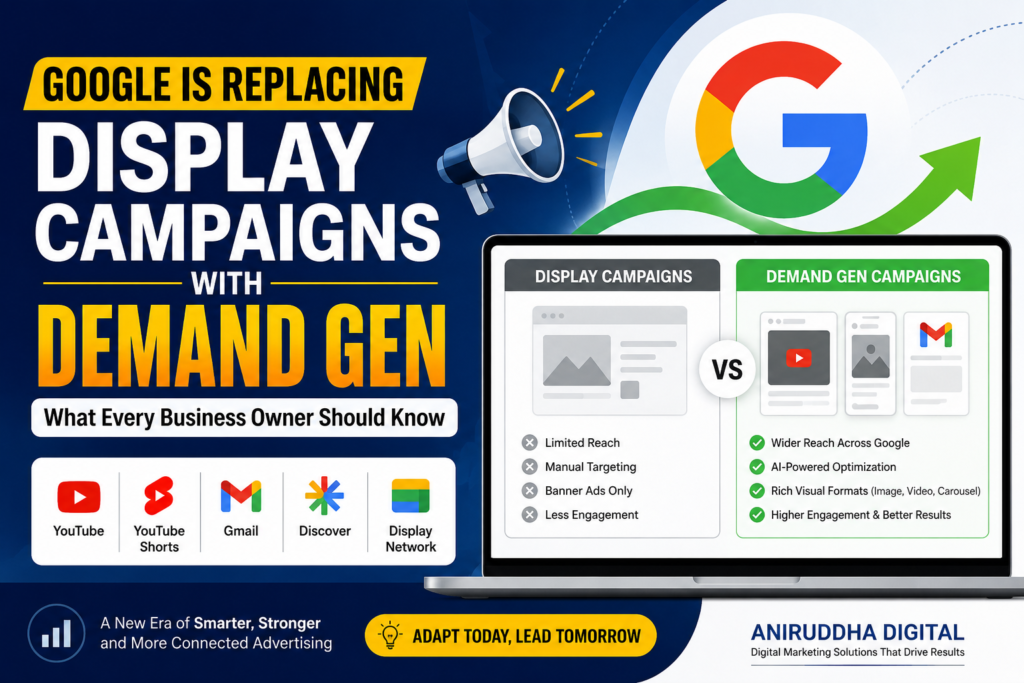
Other Google advertising formats, including Performance Max and Demand Gen, can support customer acquisition and brand visibility across different stages of the buying journey.
Read more about Google’s move towards Demand Gen campaigns and what businesses should know.
Best suited for: Real estate, healthcare, insurance, education, professional services, B2B businesses and other categories with active search demand.
B. Meta Ads – Build Demand and Generate Leads
Meta Ads includes advertising across Facebook and Instagram.
Unlike search advertising, where people often search for something they already need, Meta Ads can introduce products and services to relevant audiences.
Businesses can use different creative formats, including:
- Image advertisements.
- Short-form videos.
- Reels.
- Carousel advertisements.
- Lead generation forms.
- Website conversion campaigns.
For example, an educational institution can use Instagram videos and Facebook campaigns to reach parents interested in school admissions.
Similarly, a real estate company can showcase property features, project locations and lifestyle benefits to generate buyer interest.
Best suited for: Real estate, e-commerce, education, insurance, healthcare, local businesses and consumer brands.
C. YouTube Ads – Build Awareness and Customer Interest
Video marketing plays an important role in explaining products, showcasing services and building brand awareness.
YouTube advertising allows businesses to communicate through video content.
For example, a manufacturing company can showcase its production facilities, product quality and infrastructure through video campaigns.
A real estate brand can use project walkthroughs, location videos and customer testimonials to build customer confidence.
YouTube campaigns can support both awareness and consideration objectives.
Best suited for: Consumer brands, real estate, manufacturing, education, automobiles and businesses with strong visual storytelling opportunities.
D. SEO – Build Long-Term Organic Visibility
Paid advertising can generate traffic quickly, but businesses should also invest in organic search visibility.
Search Engine Optimisation (SEO) helps improve a website’s visibility in search engine results.
A good SEO strategy includes:
- Keyword research.
- High-quality website content.
- Technical SEO.
- Website speed optimisation.
- Internal linking.
- Relevant backlinks.
- Local SEO.
SEO can help businesses attract relevant visitors without paying for every website click.
It generally takes time to build meaningful organic visibility, so businesses should consider SEO as a long-term growth investment.
4. Build a Conversion-Focused Website
Running advertisements is only one part of the marketing process.
What happens after someone clicks on your advertisement is equally important.
Imagine spending ₹50,000 on advertising and generating 1,000 website visitors. However, if the website is confusing, slow or difficult to navigate, many potential customers may leave without submitting an enquiry.
This creates unnecessary marketing expenses.
A conversion-focused website should have:
Clear messaging: Visitors should quickly understand what the business offers and why they should choose it.
Strong call-to-action buttons: Options such as “Get a Quote”, “Book a Consultation” or “Enquire Now” should be easy to find.
Mobile-friendly design: The website should work smoothly across smartphones, tablets and desktops.
Simple enquiry forms: Avoid asking for unnecessary information that may discourage potential customers.
Trust elements: Add relevant testimonials, customer reviews, certifications, case studies and business information.
Fast loading speed: A website should provide a smooth browsing experience.
Businesses should also create dedicated landing pages for different campaigns instead of sending every visitor to the homepage.
A well-designed landing page can improve the chances of converting advertising traffic into genuine enquiries.
5. Why Lead Quality Matters More Than Lead Quantity
Lead generation is one of the most important objectives for businesses operating in real estate, insurance, education, healthcare and professional services.
However, many companies make the mistake of measuring campaign success only through the number of leads generated.
A better approach is to evaluate the complete lead journey.
For example:
| Performance Metric | Example |
|---|---|
| Total advertising spend | ₹1,00,000 |
| Total leads generated | 500 |
| Cost per lead | ₹200 |
| Qualified leads | 150 |
| Sales opportunities | 50 |
| Final customers | 15 |
In this example, the business generated 500 leads, but only 15 became customers.
This information helps marketing and sales teams understand where improvements are required.
Businesses should connect their advertising platforms with CRM systems to track lead status, sales follow-ups and final conversions.
A proper lead classification system can include:
- New lead.
- Contacted lead.
- Qualified lead.
- Interested prospect.
- Site visit or meeting scheduled.
- Converted customer.
- Invalid or duplicate lead.
This creates a clearer picture of actual marketing performance.
The objective should be to generate more qualified business opportunities, not simply more form submissions.
6. Track the Right Marketing KPIs
Data-driven marketing decisions are essential for improving campaign performance.
Businesses should monitor important KPIs regularly instead of focusing only on clicks and impressions.
Here are some key metrics:
Cost Per Lead (CPL): Measures how much advertising investment is required to generate one lead.
Formula: Total Advertising Spend ÷ Total Leads.
Cost Per Qualified Lead: Measures the advertising cost required to generate one qualified prospect.
Formula: Total Advertising Spend ÷ Qualified Leads.
Conversion Rate: Measures the percentage of visitors or leads who complete a desired action.
Formula: (Total Conversions ÷ Total Visitors) × 100.
Customer Acquisition Cost (CAC): Measures the total cost involved in acquiring a new customer.
Return on Ad Spend (ROAS): Measures the revenue generated for every unit of advertising expenditure.
Formula: Revenue Attributed to Ads ÷ Advertising Spend.
For example, if a business spends ₹50,000 on advertising and generates ₹2,00,000 in attributable revenue, its ROAS is 4x.
However, ROAS is not the same as profit. Businesses should also consider product costs, operational expenses, discounts and other overheads when evaluating profitability.
The right KPIs depend on the business model and campaign objective.
7. Use Data to Continuously Optimise Campaigns
Performance marketing is not a one-time activity.
Campaigns need regular monitoring, testing and optimisation.
A structured optimisation process should include:
Step 1: Analyse campaign performance
Identify which campaigns, audiences, keywords and creatives are generating meaningful results.
Step 2: Evaluate lead quality
Discuss lead feedback with the sales team and identify irrelevant enquiries, duplicate leads and genuine opportunities.
Step 3: Test different creatives
Experiment with different images, videos, headlines, offers and calls to action.
Step 4: Improve landing pages
Analyse website behaviour, enquiry form completion rates and user experience.
Step 5: Reallocate budgets
Invest more in campaigns that generate qualified opportunities while reviewing or reducing inefficient spending.
Step 6: Review results regularly
Prepare weekly and monthly reports to understand campaign performance and identify the next set of improvements.
Continuous optimisation helps businesses use their marketing budgets more effectively.
8. Common Performance Marketing Mistakes Businesses Should Avoid
Even businesses with significant advertising budgets can struggle to achieve the expected results.
Some common mistakes include:
1. Focusing only on cheap leads: Low-cost leads may not always represent genuine customer interest.
2. Running campaigns without a clear strategy: Advertising without defined objectives, audience research and budget planning can waste money.
3. Ignoring website experience: Poor landing pages and complicated enquiry forms can reduce conversions.
4. Not tracking conversions properly: Incorrect tracking can lead to misleading performance reports.
5. Ignoring CRM and sales feedback: Marketing teams need information about what happens after a lead is generated.
6. Using the same creative for every audience: Different customer segments may respond to different messages and offers.
7. Ignoring customer trust: Misleading advertisements, fake reviews and unclear product claims can damage brand credibility. Learn how to identify fake reviews, AI-generated UGC videos and misleading marketing.
8. Stopping optimisation too early: Campaign performance should be evaluated using sufficient data rather than making decisions based on short-term fluctuations.
Avoiding these mistakes can help businesses build a more structured and sustainable digital marketing system.
9. How to Build a Performance Marketing Strategy for Your Business
A successful performance marketing strategy should connect business objectives with marketing activities.
Here is a practical framework businesses can follow.
Step 1: Define your business goals
Decide whether your priority is lead generation, online sales, customer acquisition, brand awareness or market expansion.
Step 2: Understand your target customers
Research your audience, location, requirements, buying behaviour and decision-making process.
Step 3: Select the right marketing channels
Choose suitable platforms based on customer intent and business objectives.
Step 4: Plan your marketing budget
Allocate budgets based on business priorities, market opportunities and expected performance.
Step 5: Develop relevant creatives and landing pages
Create advertisements and website experiences that clearly communicate your value proposition.
Step 6: Implement tracking and CRM integration
Ensure that leads, conversions, advertising expenditure and sales outcomes can be measured.
Step 7: Monitor, analyse and optimise
Review performance regularly and improve campaigns using actual business data.
This approach creates a more organised marketing process and helps businesses make better growth decisions.
Conclusion: Turn Marketing Investment into Business Growth
Performance marketing is much more than running advertisements on Google, Facebook or Instagram.
It is about building a complete customer acquisition system that connects audience targeting, advertising, website experience, lead generation, CRM, analytics and sales outcomes.
Businesses that focus on meaningful performance indicators can make better marketing decisions, reduce wasted advertising expenditure and improve customer acquisition.
However, sustainable growth does not happen overnight. It requires the right strategy, continuous optimisation, quality content and a clear understanding of customer behaviour.
Whether you are a startup, real estate company, manufacturing business, educational institution or established brand, a structured performance marketing strategy can help you move towards measurable business growth.
The objective is not simply to spend more on marketing. It is to make every marketing investment work harder for your business.
Frequently Asked Questions (FAQs)
1. What is performance marketing in digital marketing?
Performance marketing is a measurable digital marketing approach focused on achieving specific business objectives such as leads, sales, website conversions and customer acquisition.
2. How does performance marketing help business growth?
It helps businesses reach relevant audiences, generate qualified leads, track advertising costs, improve conversion rates and measure marketing returns.
3. Which platform is best for performance marketing?
Google Ads and Meta Ads are popular platforms. Google Ads is useful for reaching people actively searching for products or services, while Meta Ads helps businesses build interest and generate demand. The best platform depends on the target audience and business objectives.
4. How much should a business spend on digital marketing?
There is no fixed advertising budget for every business. The budget depends on industry competition, target locations, customer acquisition costs, business goals and available resources. Businesses should start with a realistic testing budget and scale based on performance.
5. What is a good Cost Per Lead (CPL)?
A good CPL depends on the industry, product price, customer lifetime value and lead quality. A low CPL is not necessarily profitable if the leads do not convert into customers.
6. How long does it take to see results from performance marketing?
Paid campaigns can start generating traffic and enquiries soon after launch, but meaningful optimisation requires testing and sufficient data. The time required to generate sales depends on the industry, sales cycle, competition and campaign strategy.
7. Is SEO important for performance marketing?
Yes. SEO supports long-term organic visibility and helps businesses attract relevant visitors through search engines. Combining SEO with paid advertising can create a more balanced digital marketing strategy.
8. Why is CRM integration important for lead generation?
CRM integration helps businesses manage enquiries, track follow-ups, classify lead quality and understand which marketing campaigns generate actual customers.
9. Can small businesses benefit from performance marketing?
Yes. Small businesses can use targeted campaigns to reach relevant local or national audiences, generate enquiries and measure marketing expenses. The strategy and budget should match their business capacity.
10. How can I improve my existing digital marketing campaigns?
Start by reviewing campaign targeting, advertising creatives, landing pages, conversion tracking, lead quality and sales feedback. Identify the biggest performance gaps and prioritise improvements based on business impact.
Ready to Grow Your Business with a Smarter Marketing Strategy?
Connect with Aniruddha Ghosh to discuss your digital marketing requirements and explore a practical, ROI-focused growth strategy for your business.
Visit AniruddhaDigital.com to learn more about performance marketing, digital advertising, lead generation and business growth.


Leave a Reply